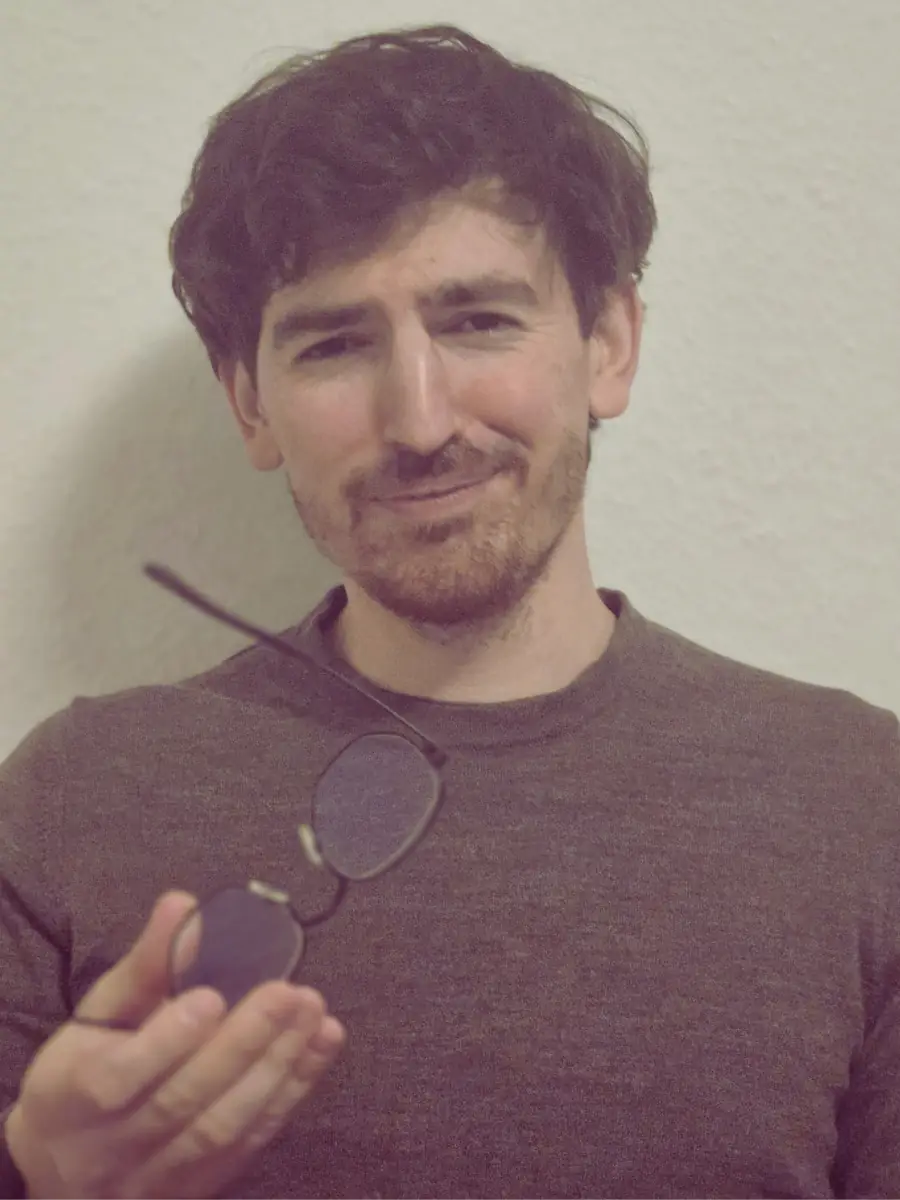
I come from a line of teachers. My father, my grandmother, her father before her. Not French teachers necessarily, but people for whom transmitting knowledge was something close to sacred.
I studied French for years in school. I do not speak a word of it now. I always regretted it.
I have heard a version of that sentence hundreds of times. From smart, accomplished adults. Engineers, lawyers, designers, retirees. People who speak two or three languages fluently, just not the one they spent five or seven or ten years studying.
They do not say it with indifference. They say it with a specific kind of sadness, the sadness of someone who tried, who invested real time, who was told they were learning, and who walked away with nothing usable. They feel a little foolish about it. They should not.
They did not fail French. French education failed them. And since leaving school, the tools that promised to fix it (the apps, the streaks, the endless gamification) have done, in many ways, something worse than school: they have replaced one bad system with another, dressed up to look like progress.
My first book at university in Nîmes was about how adults learn. I read it before anyone tried to teach me anything. Years later, recruiting tech talent across Europe, I kept hearing that same apologetic sentence about French. It hurt. I was hurt for my language and hurt for my country. I am going to tell you, as plainly as I can, why none of the existing methods has worked, and what an adult who actually wants to speak French has to do instead.
Part 1Why nothing has worked
There are three culprits, and they stack.
The first is school. The way French is taught in most school systems (and I say this having been educated in France and having taught adults who went through American, British, German, and Australian systems) is structurally wrong for language acquisition. Classes are generic. They treat thirty different brains as if they were one. They teach grammar as a set of abstract rules to be memorized, rather than as patterns your brain can absorb through meaningful use. And critically, nobody ever teaches the student how to learn. You are handed a textbook and told to study. That's it. The metacognitive layer, how memory actually works, when to review, when to rest, what to do between sessions, is entirely missing. No wonder almost nothing sticks.
The second is the modern language app. I want to be careful here, because I don't think the major platforms are evil. Many of them, in their early years, were genuinely useful tools. But the business model these platforms operate under has pulled them, inevitably, toward a single master metric: engagement. Time spent in the app. Streak maintained. Daily active users. These are the numbers that matter to platforms whose revenue depends on ads, subscriptions, and retention.
The problem is that engagement and learning are not the same thing. In fact, past a certain point, they are opposed. A platform optimized for engagement will give you the dopamine hit of completing an exercise without the cognitive load of actually producing language. It will reward you for a long streak, a streak that, from a learning perspective, means almost nothing if the exercises themselves weren't demanding enough to force real memory consolidation. The apps simulate learning. They don't cause it. And because they're beautifully designed, because they make you feel like you're doing something, because they tap into the same dopamine circuits as slot machines, they are extraordinarily hard to let go of, even when some part of you knows they aren't working.
The industry treats adult learners as if they were children who need to be tricked into showing up.
This is what I find most offensive about the current state of language learning, and I'll say it directly: the industry treats adult learners as if they were children who need to be tricked into showing up. As if motivation were a bug to be patched over with badges and confetti animations. As if an adult couldn't be trusted to do something difficult because it's worth it.
It is deeply infantilizing. And the results, or rather, the absence of results, speak for themselves.
The third culprit is the promise itself. "Fluent in three months." "Speak like a native in 15 minutes a day." "Effortless French." These are not claims. They are lies. Not outright lies in the legal sense, because nobody defines "fluent" or "effortless" clearly, but lies in the moral sense, because they create an expectation the product cannot meet. And when the learner doesn't reach fluency, the implicit message is that they failed. Not the method. Not the promise. Them.
Which is how you end up with smart, capable adults telling me, apologetically, that they gave up on French. They didn't. The promise gave up on them.
Part 2What the science actually says
Let me shift registers.
I hold a Master's degree in Social and Organizational Psychology. I spent six years as a professional recruiter, a job that is, at its core, the practice of reading how humans learn, adapt, and integrate into new environments. I tutored university students in Neuropsychology and Social Psychology. I still read the literature. I am surrounded in my daily life by clinical and social psychologists.
I mention this for one reason. What follows is not the opinion of a language teacher who has become attached to his method. It is what decades of research on adult learning, memory, and motivation have established, consistently, across cultures and fields.
Here is what is actually true.
Your adult brain is built to learn. You just need the right method. The most damaging idea floating around in language education is that adults are somehow at a disadvantage, that we have to fight against our own biology to learn a new language. It is not true. As an adult, you have something extraordinary: metacognition, abstract reasoning, life experience that anchors vocabulary in real meaning, and the ability to deliberately structure your own practice. Used properly, those advantages give you a clear path to fluency. The reason most adults fail is not their age. It is the absence of method, structure, and the right reflexes. Give them those, and they progress reliably.
Short sessions, repeated, beat long sessions every time. The idea that you need two hours of daily study to make progress is false. What works is the opposite: short, dense, focused sessions of around twenty minutes, with the material revisited again later in the same day, and again the next day. The exact rhythm is part of what I teach my students, but the principle is simple, and the research has been clear about it for decades. Work smart, not long. An hour of properly distributed practice will beat three hours of one continuous session. Most adults assume they need more time. They actually need a better structure for the time they already have.
Rest is not a break from learning. It is a phase of learning. The consolidation of memory, the moving of information from short-term into long-term storage, happens largely outside of study time. Sleep does the heaviest lifting. But so does walking, showering, quiet moments. If you push too hard, too often, without structured rest, you don't accelerate learning. You degrade it. This is one of the first things I teach my students, because once they understand it, they stop feeling guilty for the hours they're not working and start treating rest as part of the practice.
Semantic association beats translation. Every time. When you learn the word chien by memorizing "chien = dog," you are asking your brain to do two jobs: retrieve the English word, then retrieve the French one. Every time you speak, you translate. You will never be fluent that way, because fluency is the ability to access language directly, without the English middle step. When you learn chien by associating the French word directly with an image (the shape, the four paws, the wagging tail), you bypass English entirely. Your brain builds a direct neural pathway from concept to word. The first time that pathway fires without a translation step, you will feel it. My students almost always do, and they tell me about it, usually sometime during the image description module, which is where the breakthrough tends to happen.
Timing matters. Context matters. What you do between sessions matters. There are better and worse hours to study. There are things to do, and things to avoid, in the minutes and hours after a session ends. There are ways to make review feel like nothing at all. These are not tricks. They are the direct application of what we know about attention, consolidation, and interference. And they are almost never taught.
The platforms don't teach you any of this. They can't. Teaching you to learn independently, efficiently, with self-knowledge, would free you from needing the platform. The business model requires you to keep coming back.
I want you to be free of the platform.
Part 3The adult, respected
I am going to tell you what Le French Please is, and what it is not.
It is not a game. There are no badges. There are no streak notifications designed to trigger your loss aversion at 11:47 p.m. when you're already in bed. There are no confetti animations congratulating you for five minutes of anything.
It is not magic. It is structured, demanding, respectful work, grounded in how adult memory and motivation actually function.
I want to talk to you about pace honestly, because this is where most language teachers either oversell or undersell. What matters first is not speed. It is the quality of what you build. My method is deliberately patient at the start. We spend time laying foundations that other courses skip, because everything you learn afterwards has to rest on something solid. I think of it as building a fortress. The first weeks feel slow. They are not slow. You are setting stone after stone of something that will not collapse on you in six months when life gets busy and you stop reviewing for a week.
Here is a real example, anonymized. A student of mine, in her early forties, started from absolute zero. She works full time and gives the language one hour a week of structured practice with me. What she also does, and this is the part that matters, is follow my learning method during the rest of the week, on her own. Ten months in, she narrates her days in the present tense and the past tense without hesitation, has an accent that is genuinely understandable, and can navigate everyday interactions in French. One hour a week of class, plus the method she applies between sessions. That is the formula.
Could she go faster with more sessions? Of course. Some of my students do exactly that, and their progress is correspondingly faster. But the reason her result is meaningful is that it is real, durable, and built to last. Whatever she has learned, she has learned in a way that will not evaporate. That is the promise I make: not a calendar, but a guarantee of quality. Once the foundation is in place, you can navigate freely. You can accelerate when you want, slow down when life demands it, and what you have will still be there.
It is designed for a specific kind of person. The adult who is tired of being talked down to. Who doesn't want a jingle. Who would rather be told the truth about what the process requires, and then given the tools to do it properly, than be sold a fantasy and asked to blame themselves when the fantasy doesn't deliver.
If that isn't you, close this page. There are apps for the other kind of learner, and some of them are very pleasant.
If you are, if you are the kind of person who would rather do something real for thirty minutes than something fake for two hours, then let me tell you what the path actually looks like.
Part 4The path
You will spend your first weeks on foundations. Not the alphabet recited like a child, but the alphabet anchored to images, because from day one we are building a French mental space that doesn't route through English. Then pronunciation. Then the first verbs, fully conjugated, in real sentences. It will feel slow. It is not slow. You are laying track that the rest of the course will run on.
Then, somewhere around the fourth module (I know this because it happens with almost every student), you will describe an image in French. Not translate. Describe. And you will notice, during or just after, that for a brief moment you were not thinking in English. You were thinking in French. That moment is the point of no return. From there, everything is elaboration.
And that elaboration happens, in my experience with private students, through what I call bricks. In each lesson I add one piece: a linking word, a relative pronoun, a tense, a turn of phrase. It slots into what the student already has. They leave the session having built something slightly more complex than what they came in with, often without fully realizing it. That is the design: no lesson ever feels overwhelming, but across ten, twenty, forty lessons, the compound effect is enormous. The brain learns best when each new element is just beyond reach, attached to something already mastered. This is the principle, and the curriculum is built around it.
The goal is not to speak French once. It is to never lose it again.
The final thing I want you to understand about the path is this: the goal is not to speak French once. It is to never lose it again. Every student I work with learns not only the language but the metacognitive toolkit: the understanding of how their own memory works, what a good study session looks like, when and how to review, what to do when motivation drops. That toolkit is yours for life. Even if you stopped using French for two years and came back to it, you would know exactly how to wake it up.
That is the promise, and it is the only one worth making.
A last word
If you are one of the people I described at the beginning, one of the ones who studied French for years and feels that quiet regret, I want to say two things to you.
First: it was not your fault. You were not a bad student. You were a good student inside a bad system, and then you were a busy adult targeted by platforms whose real product was your attention. You were not failing at French. You were being failed.
Second: the door is not closed. Your brain is more capable of learning this language now than the industry has led you to believe. You will need structure, a real method, and someone who respects you enough to tell you the truth about the process. That is what I try to offer.
If you want to get a rough sense of where you stand, I built a short, free placement quiz. It takes about three minutes. It is not a precise assessment (no three-minute quiz could be) but it gives me and you a useful starting point, enough to orient our first conversation if we have one. No signup, no pressure, no streak. Just a first step.
Ten years from now, you do not want to be sitting at a café table in Aix or Lyon or Strasbourg, listening to a conversation you cannot join, telling a stranger apologetically that you studied French for years and never quite got there.
You want to be in the conversation.
That is what this is for.