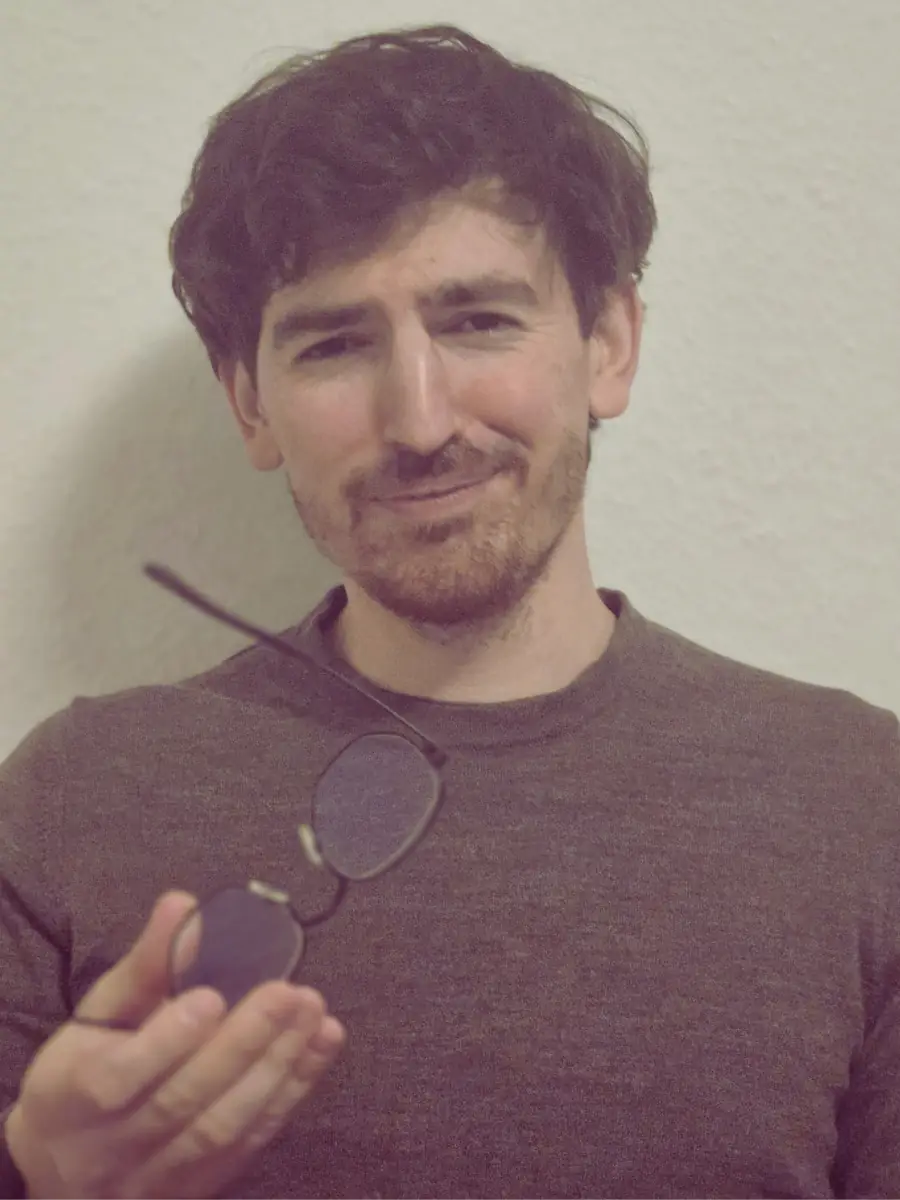
I didn't set out to build a French school. I set out, for most of my twenties, to understand how people actually learn, adapt, and integrate into new environments. The French came later, almost as a consequence.
I hold a Master's degree in Social and Organizational Psychology. During my studies, I tutored undergraduates in Neuropsychology and Social Psychology, because I noticed that the students who struggled weren't struggling with the material itself. They were struggling because no one had ever taught them how to study, how to consolidate memory, how to manage attention across a semester. I found that more interesting than the coursework.
My master's thesis was on the professional integration of male midwives, one of the first studies of its kind in France at the time. I wrote it in a month, not because I am brilliant, but because I was absorbed by the question: how do people learn to belong in a place that wasn't designed for them? That question, in hindsight, was already the question I would spend the rest of my working life on.
Six years reading humans professionally
After graduation, I spent six years as a recruiter. It is not, on the surface, the most obvious job for someone interested in the science of learning. In practice, it was the best training I could have had. Recruitment, done seriously, is the practice of reading how humans actually adapt, learn, and integrate into new roles. You spend your days trying to understand who will thrive, who will stall, and why. You watch people in the moment they are asked to change, and you see, very quickly, the patterns of who carries structure with them and who doesn't.
I learned more about motivation, resistance, and how adults respond to new demands in those six years than I had in any textbook. But recruitment itself, as a career, didn't hold me. I was useful to the companies I worked for, and I was good at it. I was also, increasingly, bored. The problem I wanted to solve was not who gets hired. It was how humans actually change, grow, and acquire new capacities in adulthood.
The accidental pivot
The move to Berlin changed things. I have lived here for the last seven years. In that time, something kept happening that I didn't at first take seriously: the people around me, friends, colleagues, acquaintances of acquaintances, kept asking me to teach them French. Not in a vague, polite way. In a specific, persistent way. They loved listening to the language. They wanted to be able to speak it. They had tried apps and courses and night classes and had gotten nowhere, and they suspected, rightly, that there was a better way.
For a long time I said no. Teaching French as a profession hadn't crossed my mind. Then, at some point about a year and a half ago, two things lined up at once. First, I realized I had been thinking about the problem for years already, through the lens of psychology: why adults fail to learn languages, what memory actually requires, how motivation collapses, what the apps were doing wrong at a cognitive level. Second, I realized the market around me was not being served. There were thousands of people in the position I just described: educated, capable, motivated, and poorly served by what the industry was offering them.
I could give them my knowledge. I could make them speak. I decided to try.
Organizational
Psychology
humans as a
recruiter
students across
time zones
represented in
my practice
What I actually care about
People sometimes ask me what I am passionate about, expecting me to say cooking, or wine, or the Loire Valley in September. I am, in fact, passionate about one thing, and it has been the same thing since I was twenty-one: I am fascinated by how the adult brain learns.
How memory consolidates during sleep. How meaning attaches to sound. Why the same person who absorbs work skills easily will struggle for years with a second language, and what it would take for them not to. How motivation survives the boring middle of any long project. How people who think of themselves as bad learners are, in almost every case, good learners who were taught badly.
This is the actual animating interest behind Le French Please. French happens to be the vehicle, because it is my native language and the one I am qualified to teach to the depth I require. But the real subject, the thing that keeps me reading, thinking, and refining my method, is the architecture of adult learning itself.
Most adults who think they are bad at languages are, in fact, fine at languages. They were simply taught by methods that don't respect how their brain works. That is a fixable problem. I fix it, for one student at a time.
What I will not do
I will not tell you that you will be fluent in three months. Fluency is not a calendar event. I can tell you, honestly, that I have beginners who started at zero and hold real conversations with me in French six months later, not restaurant phrases, but actual exchanges about their work and their lives. That result is reachable. It is also conditional on the student showing up consistently and trusting the method. I owe you the full sentence, not the marketing fragment.
I will not gamify your learning. I have no streaks, no badges, no little animations congratulating you for having opened an app. You are an adult. You came here because something in you wanted a serious path, not a toy. That is what I offer.
I will not be vague about what I charge, what I deliver, or how long things take. The industry runs on vagueness. I run on the opposite.
My commitment to you
You will not be rushed through material you haven't absorbed. You will not be talked down to. You will not be sold a fantasy and then blamed for failing to live inside it.
What you will get is a method grounded in how adult memory and motivation actually function, a teacher who treats you as a capable professional of your own mind, and the rare experience of watching your French grow in a way that doesn't evaporate the moment you stop paying attention.
If this resonates
If what you have read so far sounds like how you have always wished someone would explain language learning to you, there is a reasonable chance we would work well together. The next step is small and costs nothing.
You can take my short, free placement quiz. It is not a precise assessment. It gives both of us a useful starting point for a conversation, if we decide to have one. Or you can book a free 30-minute discovery call, where we talk directly about your goals, your history with French, and what a good path would look like.